Showing posts with label News. Show all posts

Monday, April 9, 2012

Too late for Easter: Chocolate printer to hit eBay in April, cost $4,000


Confection connoisseurs hoping to skip the whole "molded chocolate" routine for something more constructive won't have to wait long: Choc Edge's delectable 3D dessert printer is almost ready. The Choc Creator is the brainchild of Liang Hao and a kitchen of assistant cooks -- additional research at the University of Brunel, software by developer Delcam, oversight from the Engineering and Physical Sciences Research Council and funding from the Research Councils UK's Digital Economy program. Hao founded Choc Edge to distribute the completed machines, the first of which will be available from eBay on April 10th. Of course, pre-orders are also available for £2,488, or just under $4,000. Yes, the price of printing your own sweets is steep, but when you take that first bite into your custom Engadget logo -- won't it be worth it?

Inhabitat's Week in Green: autos galore, electric trees and the world's largest rooftop farm

Each week our friends at Inhabitat recap the week's most interesting green developments and clean tech news for us -- it's the Week in Green.

Electric DeLorean
Flying cars and taxis of the future drove out of our imaginations and onto the show floor of the 2012 New York Auto Show this week as autophiles poured into the Jacob Javits Center from far and wide. Inhabitat editors left no hybrid or electric cars unturned as they scoped out gems like the Fisker Karma's lower-priced but equally-sexy cousin, the Fisker Atlantic, and Infiniti's revolutionary LE electric car, which will use the world's first wireless home charging system. We were also wowed by reveals of the Lincoln MKZ hybrid vehicle and a special guest appearance by the back-to-the-futuristic electric DeLorean (shown above).

Even though we kicked the week off with some pretty plausible April Fool's Day stories, some of the actual events from the past few days proved that truth is often stranger than fiction. Case in point: this Indian man single-handedly planted a 1,360 acre forest (really makes you question what you've accomplished in your life, doesn't it?) and a spooky unmanned Japanese ghost ship was recently spotted off the coast of Canada floating aimlessly in the sea. In other news, Harry the Hermit crab was picky about his abodes until he was presented with a custom-made LEGO shell, and the electric blue trees that sprouted up in Seattle weren't stragglers from a Dr. Seuss book, but rather the work of an artist calling attention to the dangers of deforestation. On the other hand, some reforestation is about to take place in NYC, as Marty Markowitz and celebrity chef Mario Batali announced that the world's largest rooftop farm will be coming to Brooklyn in 2013. And finally, it seems the media made April Fools of themselves last week when they jumped to the false conclusion that taxpayer money was lost after Solar Trust of America filed for bankruptcy.

The world of design presented us with some inspiring new developments this week as we delved deep into tiny terrarium worlds, ogled IKEA's otherworldly new jellyfish lamp and witnessed an eco Easter egg sprout mini skyscrapers just in time for the holiday. More strides were also made in the race for cleaner energy as this young savant at the University of Delaware developed a self-sustaining solar reactor that could revolutionize clean energy as we know it and Bayer revealed a new seismic wallpaper that could actually keep walls from collapsing in an earthquake. Not to be outdone, scientists from Austria and Japan announced that they created micro-thin solar cells narrower than spider silk and Chinese researchers unlocked the secret of butterfly wings to make solar electricity more efficient. And, of course, no tech recap would be complete without an innovation from Google - the search giant just unveiled its new pair of "Project Glass" augmented reality glasses.

Upcoming tech-themed events, week of April 2, 2012

Members of the Cornell IT community and everyone with an interest in technology have several events to choose from next week. For more information, details, or to check for schedule changes, please visit the web pages for the events or contact the group that is hosting.
BOOM: Bits on our Minds 2012
Wednesday, April 4, 2012
4-6pm
Duffield Atrium
boom.cornell.edu
Today’s information science students and tomorrow’s entrepreneurs will present digital technology research projects created for the 14th annual Bits On Our Minds (BOOM) competition. BOOM is a showcase for student research and creativity using digital technologies, featuring research projects from Cornell undergraduate and master’s degree students. Projects include apps for Android and iPhone devices, instant messaging, robotics and video games. The event is free and open to the public and sponsored by Computing and Information Science in conjunction with corporate sponsors.
The Physics of a Flying R2-D2 and Other Interesting Ideas
Rhett Allain, Southeastern Louisiana University, and blogger for Wired Science Blogs
Wednesday, April 4, 2012
6-7pm
Schwartz Auditorium, Rockefeller Hall
events.cornell.edu/event/physics_on_the_internet_with_prof_rhett_allain
Professor Allain writes of his talk, “A block sliding down a plane. What is more classic for a traditional physics problem? What is more boring than this physics problem? Why do we have to just look at basic things in physics? We don’t. There are interesting and fun things all around us. In this seminar I will share some of my favorite physics applications including: How does R2-D2 fly? Why is Mole-Day not such a great day (unlike Pi-Day)? How would you stay away from a zombie in a closed room? As a bonus, I will include some thoughts on blogging as a form of communication and outreach.”
Understanding a Global Network: Research at Facebook
Friday, April 6, 2012
1:30-3:30pm
B09 Sage Hall
events.cornell.edu/event/understanding_a_global_network_research_at_facebook
With over 800 million users connected by more than 100 billion edges, Facebook represents one of the largest social network data sets in the world. This talk uses research published by the Facebook Data Team to highlight some of the opportunities and challenges of using such large scale data, including technical challenges and problems with contextualizing aggregated results. The talk will focus on how such behavioral analysis both complements and compares with survey-based approaches, and concludes with a case study of published research that combines the two methods.

Remedy OnDemand upgrade is underway. Widespread campus adoption foreseen.

The upgrade from the current version of Remedy to Remedy OnDemand, announced in late January 2012, is underway. CIT is working with BMC Software and RightStar Systems on an implementation scheduled to begin May 15.
The previously publicized plan, to upgrade Remedy users in the ten units now using the incident management tool to Remedy OnDemand and then open the door to new users, continues to be the course of action. However, since our January Remedy update, more widespread commitment to Remedy OnDemand has emerged from within the IT community.
The CIT and IT Service Group directors have decided that Remedy OnDemand will be the common campus incident management tool. This strategy will support moving tickets between units, provide the infrastructure needed for standard escalation processes, and create a vastly more collaborative and consistent support environment. However, it may not make sense for all units to adopt Remedy OnDemand simultaneously. Units that intertwine incident management with other ITIL processes and mechanisms may need to wait for the IT community to activate additional Remedy ITSM processes.
Use of a single incident management system at Cornell is a notable step toward the notion of “one IT”, not only in the way the IT support community functions, but in terms of building a more seamless end-user experience.
While there is significant campus commitment to Remedy OnDemand, it remains the intention of all stakeholders to continually track the ITSM systems market. If a cost effective incident management tool emerges that better meets Cornell’s needs, IT will seriously consider moving to it. The potential for migrating to a new tool in the future is a significant reason for keeping Cornell’s customizations to Remedy OnDemand to a minimum.
The Remedy team is currently working with BMC and RightStar to validate data being shifted to the new system (foundation data) and to identify issues that must be addressed during Remedy OnDemand activation and onboarding phases. These include:
  • Working through the implications of “starting fresh”—not pulling legacy tickets into the new system.
  • Finalizing the Service Catalog that has been under revision and integrating it into Remedy OnDemand.
  • Reflecting CIT’s support structure in Remedy work groups which are associated with ticket escalation.
  • Understanding required metrics and making configuration decisions that support them.
For questions about Remedy OnDemand or the upgrade process, please contact Benoit McNicoll (bm343), service manager.

9 Most Read Channel Partner Stories, April 6

Readers spent a lot of time this week reading channel news and analysis blogs across our blog network: The VAR Guy, MSPmentor and Talkin' Cloud. But which nine technology news stories and analysis pieces generated the most readership? Glad you asked. Here are our nine most read entries for the week ending April 6, 2012.
  1. Think Again: What’s the one trait most VARs and MSPs lack? Sales skills? Marketing skills? Actually it’s something far more basic, according to ConnectWise CEO Arnie Bellini. Here’s his answer.
  2. The Cloud War: Everyone is taking about the Citrix CloudStack vs. OpenStack battle. But is the open source cloud battle real or perceived?
  3. Google Chromebooks vs PCs: What’s the total cost of ownership of Google Chromebooks vs traditional PCs? Google offers a pricing calculator that generates an alleged answer. But what’s the bigger story with Chromebooks? Talkin’ Cloud offered an update.
  4. Big Box Challenge: As Best Buy closes some stores, can the company’s managed services business — mindSHIFT — thrive? We’ve got some exclusive insights.
  5. Nimsoft CEO Exits: Changes are afoot within CA Technology’s MSP software division. MSPmentor had the original story here. But the follow-up just went live here. ...

Cricket Photos of the Week 8.4.12

This week: IPL razzmatazz, Tendulkar in unfamiliar territory, England's fightback and more.

http://l.yimg.com/bt/api/res/1.2/K4ckWqMtezM.J4E9._sE6g--/YXBwaWQ9eW5ld3M7Zmk9Zml0O2g9MTI0NjtxPTg1O3c9OTUw/http://l.yimg.com/os/153/2012/04/08/142462759-10-jpg_085207.jpg

Dancers perform a routine before the start of the IPL Twenty20 cricket match between Kolkata Knight Riders and Delhi Daredevils at The Eden Gardens Cricket Stadium in Kolkata. (DIBYANGSHU SARKAR/AFP/Getty Images)

Read More :  http://cricket.yahoo.com/photos/cricket-pictures-of-the-week-8-4-12-slideshow/cpotw-photo-1333874576.html#crsl=%252Fphotos%252Fcricket-pictures-of-the-week-8-4-12-slideshow%252Fumpire-rauf-tries-shot-water-break-during-third-photo-093948001.html

Sunday, April 8, 2012

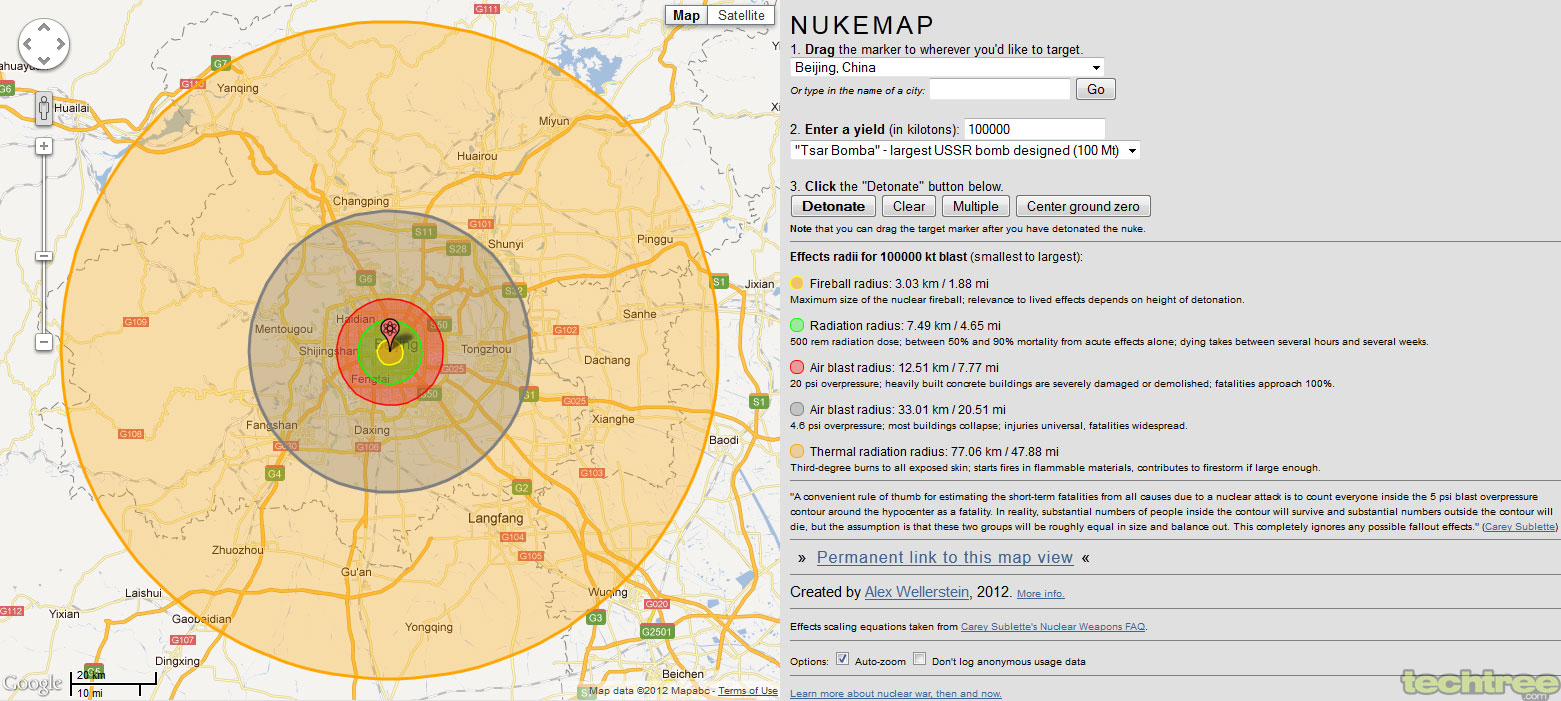
What Would Be The Effects Of A Pak Nuke Over Delhi?

TechTree Blog: What Would Be The Effects Of A Pak Nuke Over Delhi?
The atomic bomb is arguably the deadliest creation of mankind; it has the power to destroy humanity like no other instrument of mass destruction. Even though it has been used only twice as a weapon against an enemy nation, the resultant consequences have left such an indelible mark on the human psyche, that any sane nuclear-capable nation will not think about using it again. Sadly though, we cannot say the same about rogue nations.

While we surely hope that the atomic bomb would never be used again, a website has posted a nifty tool to help anyone simulate a nuclear explosion and estimate the damage that such a weapon can unleash at any point on this planet. It gives an insight into the level of devastation that can be caused, by allowing you choose the kiloton yield of the bomb and the location using Google Maps on which you want to simulate a ground zero. Alternatively, you can choose from a list of the most important cities in the world or locations of historic detonations and also choose bomb presets based on actual known atomic weapons produced thus far. It is even possible to select multiple destinations to simulate coordinated simultaneous attacks.

TechTree Blog: What Would Be The Effects Of A Pak Nuke Over Delhi?Once you select the location and bomb yield, and press the Detonate button, the damage results are displayed in the form of five circular overlays on the map with different colours, each colour signifying a certain level of damage. This includes the smallest circle, which is the actual fireball at ground zero, to the maximum radiation radius, which results in third-degree burns and very high mortality. It must be noted that this does not take into account the after-effects of radiations that can spread to other areas and the radiation-related genetic abnormalities that are carried down across generations of affected human beings who manage to survive.

It is more horrifying than interesting to note that the power of nuclear weapons have grown manifold since the Manhattan Project. The 16 kiloton Little Boy dropped on Hiroshima had a diameter of 3.6 km with total fatality, which is just about the size of a typical suburb. In contrast, a 10.4 megaton day thermonuclear weapon such as the Ivy Mike has a 31.2 km diameter of total fatality, which can easily encompass an entire metropolis. With these details, you can also estimate the damage caused by the largest known atomic weapons of countries such as India, Pakistan, North Korea, or China. There is even a preset value for a 100 ton "dirty bomb" that can supposedly be prepared by terrorists.

The fact that this website has already recorded over 1.7 million (and counting) simulated explosions points at the widespread interest such an analytical portal can generate. However, the real message of the site is how nuclear weapons have the potential to quickly wipe off all life, and how it is therefore necessary to generate a general consensus about global nuclear disarmament. We can only hope that this message gets across to the right people and that this site does not turn into just another video game.

Interview: Thomas Clayton, Bubble Motion

Interview: Thomas Clayton, Bubble Motion
Do we really need another social network? While several social networking services failed to make the desired impact, the eco-system is still up and running. With services such as Twitter and Facebook still going strong, more names are trying to create a mark for themselves in the arena. After text and video, it's the turn for voice-based services to enter the ring. Bubble Motion's latest flagship service named Bubbly, described as "Twitter with a voice", is one such example. With the iPhone app launched recently, we caught up with the company's CEO Thomas Clayton to understand how this app works, what its scope is, and whether we truly require yet another social network to stay connected.

The service seems to be placed somewhere between Twitter and Youtube. Historically, people seem to prefer a more audio-visual medium rather than just a voice-based service. How do you expect it to compete with major players?
We are not really competing against these guys; the service is actually more complementary. Therefore, every time I post a bubble, it will directly enter my Twitter feed, and every time I tweet, it will appear in my Bubbly feed. It is all deeply integrated and is definitely very similar to Twitter except that the medium is audio instead of text.

Your website depicts that Motion Bubble is more of a VAS. Would such services continue?
We have tied up with a few telecom service providers, but now that has changed. We need to change the positioning on the website.

Will Bubbly be available for the desktop platform soon, or will it be limited to smartphones only?
For now it's on mobile phones; both feature phone and smartphone. You get a visual interface with smartphones and the nature of audio in general is more apt for mobiles than desktops. Hence, when you are listening to audio clips or generally networking, you are typically travelling. When you are recording, you're definitely not going to sit in front of a computer, you are most likely going to be out moving or stuck in traffic. We will always have a web presence, but most of our content will be produced and consumed off mobile phones.

Are these bubbles time bound like in case of tweets, or would it also double up as an audio-blogging platform?
We are predominantly focusing on microblogging, we don't focus on long rants or raves, although some of the celebs like to talk, so we had to increase the duration from 30 seconds to 90 seconds and that is a lot of information.

The apps' layout is very similar to Twitter, any fear of it being called a rip off?
Most social networking apps usually follow a similar layout. We took the UI from different areas and Twitter wasn't even on that list.

Like Twitter, do you have a mechanism to verify celebrity accounts?
We go to the celebs directly. For example, we will meet up with Mr. Bachchan and say "hi Mr Amitabh Bachchan, would you like to use our service and give us your code". Right now it's safe because it's not a scalable model and we personally go out and do that.

Considering that the app launched recently, how many registered Indian users does the service have at present?
The service launched about a year and a half ago. There are about 15 million users in total, in which about nine million are Indians.

How successful has the service been so far? What kind of feedback have you received from users?
The feedback in general seems positive, but the numbers speak for themselves; we have millions of retrievals and posts every month. The activity level is very high and it is growing every single month. If it was a bad service people wouldn't stay.

What kind of user base do you expect in the coming months in India?
Consumer service is more of a viral boost, so we depend more on word of mouth. Therefore, going by the current rate, we will surely double in the next year. We don't have targets; we just want more and more users to use the service.

There is a lot of talk about internet censorship and copyright issues making the rounds. Does being a vocal service make it vulnerable to such restrictions?
We are open to all kinds of content. One of our famous bloggers is Anna Hazare, who was blogging from his hospital bed. What we have here, is have another medium to reach out to the world. We are also launching services in almost every major country except China, for obvious reasons.

Don't you worry about copyrighted content making way into the service?
The content is end-user moderated, so if somebody flags any content, then it will be taken care of. Considering the volume of data that comes in, it's not possible to keep a check, hence we prefer to follow this model.

A Tattoo Can Tell You Who's Calling

TechTree Blog: A Tattoo Can Tell You Who's Calling
Nokia sure knows how to get under your skin, and with this new patent, it wants to make sure it's the only company that should be able to do it. While some of their old concepts have been interesting, this one is a bit too farfetched. As per the submitted patent, the ferromagnetic ink-based tattoos on your skin will vibrate based on commands from your phone. The material used can detect a magnetic field, and emit a vibration. This can be used as a device or as a tattoo, depending on the wearer's preferences, and can be paired with a phone that can emit varying magnetic fields. With the help of these variations, different patterns can be set to inform the user of the phones activities (such as a call, text, or low battery) by controlling the substance magnetically.
When users opt for a tattoo, demagnetized ferromagnetic inks will be used to create the design. After it is ready, the tattoo will be magnetised by bringing it "several times over magnet to magnetize the image material again". Does it sound cool or creepy to you, and would you get yourself a magnetic tattoo when it actually sees light of day?

The cutest celebrity kids ever

Celebrity babies are as famous as their parents. Here’s a list of little stars who make the world go gaga.

 http://l.yimg.com/bt/api/res/1.2/ZTG7c9zulG9uewjqDjYuWA--/YXBwaWQ9eW5ld3M7Zmk9aW5zZXQ7aD0xMTU3O3E9ODU7dz02MzA-/http://l.yimg.com/os/401/2012/04/06/suri-jpg_092606.jpg

Suri Cruise: The daughter of Tom Cruise and Katie Holmes constantly makes headlines for her enviable wardrobe and her fetish for shoes. The biggest newsmaker was her being named in the list of the Best Dressed Women by Glamour magazine. Pushing the whole debate of the "too-young-for-all-these" aside, we cannot help but gush at everything this gorgeous child wears or does.

Read More : http://in.lifestyle.yahoo.com/photos/the-cutest-celebrity-kids-ever-slideshow/shiloh-jolie-pitt-photo-1333703302.html

http://l.yimg.com/bt/api/res/1.2/zS8bfsWOpiVA3j59rdD_Vw--/YXBwaWQ9eW5ld3M7Zmk9aW5zZXQ7aD0xMDM1O3E9ODU7dz02MzA-/http://l.yimg.com/os/401/2012/04/06/shilioh-jpg_090814.jpg

Too much sitting linked to shortened lives

People who spent a lot of time sitting at a desk or in front of a television were more likely to die than those who were only sedentary a few hours a day, according to an Australian study that looked at death rates during a three-year period.
Researchers, whose results appeared in the Archives of Internal Medicine, found that the link between too much time sitting and shortened lives stuck even when they accounted for how much moderate or vigorous exercise people got, as well as their weight and other measures of health.
That suggests that shifting some time from sitting to light physical activity, such as slow walking or active chores, might have important long-term benefits, they added.
"When we give people messages about how much physical activity they should be doing, we also need to talk to them about reducing the amount of hours they spend sitting each day," said Hidde van der Ploeg, the new study's lead author from the University of Sydney.
Of more than 200,000 adults age 45 and older, van der Ploeg and her colleagues found that people who reported sitting for at least 11 hours a day were 40 percent more likely to die during the study than those who sat less than four hours daily.
That doesn't, however, prove that sitting itself cuts people's lives short, she noted, adding that there could be other unmeasured differences between people who spend a lot or a little time sitting each day.
The team surveyed about 220,000 people from New South Wales, Australia, between 2006 and 2008, including questions about participants' general health and any medical conditions they had, whether they smoked and how much time they spent both exercising and sitting each day.
Then the research team tracked responders using Australian mortality records for an average of almost three years, during which 5,400 - between two and three percent - died.
They found that the extra risk tied to sitting held up regardless of whether people were normal weight or overweight, how much time they spent working out and whether they were healthy or had pre-existing medical conditions.
Van der Ploeg said too much sitting may affect blood vessels and metabolism by increasing fats in the blood and lowering "good" cholesterol levels.
"When you are standing or walking, your leg muscles are constantly working which helps to clear blood glucose and blood fats from the blood stream," she said. "If you are sitting, this is not happening because the muscles are not active."
The findings are consistent with other recent studies suggesting health consequences from too much sitting, said Mark Tremblay, an obesity and activity researcher at Children's Hospital of Eastern Ontario in Canada.
"Sitting or reclining, especially in front of screens, is bad for you regardless of your age," said Tremblay, who wasn't involved in the study.
He added that even though people tend to think they're okay as long as they work out a certain amount a day, that's not necessarily the case.
"Getting your 30 minutes of physical activity five times a week is not insurance against chronic disease.
Both he and Van der Ploeg said there were ways that even people who have jobs involving a lot of desk work can train themselves to regularly interrupt sedentary behavior, such as standing up while on the phone or holding a stand-up meeting.
"Make sure the fax machine is four steps away from you, not within reaching distance," Tremblay said.
"Drink enough water that you have to pee four times a day. Stand up, stretch, walk around a little bit, say 'hi' to your friend in the cubicle next door."
SOURCE: http://bit.ly/Hi0niK

Houston death report details drug signs, last day

http://i1.mailcdn.com/408/1186408,h=440,pd=1,w=300.jpg 
LOS ANGELES (AP) — The hotel room where Whitney Houston died bore the hallmarks of a traveler — suitcases and room-service food and drinks. But it also contained something tragically familiar for the singer: signs of cocaine and its paraphernalia.
The drug was found throughout Houston's body, according to an autopsy report released Wednesday that gave the most detailed account yet of how the Grammy-winning singer died just hours before she was to appear at a pre-Grammy Awards party. By the time an assistant found her face down in a bathtub on the afternoon of Feb. 11, Houston had likely been dead for at least an hour. The water was so hot it scalded part of her body.
Nearby, on the bathroom counter, investigators found a small spoon described by investigators as having a "crystal-like substance" in it and in a drawer they discovered a white powdery substance. The dozen prescription drug bottles found in Houston's suite of the Beverly Hilton Hotel led investigators to initially suspect she died of an overdose, but after further examination and toxicology results they concluded she drowned accidentally. Heart disease, which caused a 60 percent blockage in one of her arteries, and cocaine use were listed as contributing factors.
Toxicology results also showed Houston had marijuana, Xanax, the muscle relaxant Flexeril, and the allergy medication Benadryl in her system, but none are considered factors in her death. The grim accounting of the room where Houston died and what investigators found provide a sad footnote to the singer's life, showing the impact drugs took on her. An investigator noted a hole in the singer's nose, listed under "history of substance abuse."
Houston, 48, had been preparing for the annual party of her mentor, Clive Davis, who helped launch her career two decades earlier. She had finished work on her return to acting by starring in a remake of the film "Sparkle," which would also feature her rendition of the gospel classic "His Eye Is on the Sparrow."
The singer had a sore throat and her assistant suggested she take a bath to get ready for the party. The assistant left to pick up some items at a department store and by the time she returned, Houston was submerged in the tub, which was overflowing and had soaked the carpet in another room.
Efforts were made to revive the Houston, including using a defibrillator, according to the report. Coroner's officials declined to discuss details in the report, including whether toxicology results showing the level of cocaine in Houston's body could be used to determine how recently she took the drug. The office has said there were signs of recent and chronic use by the singer.
Beverly Hills police have been awaiting the report before closing the report, although the agency has said there are no signs of foul play in Houston's death. The singer had battled addiction for years, but friends and family have said she appeared committed to making a comeback in the months before her death.
"The biggest devil is me. I'm either my best friend or my worst enemy," Houston told ABC's Diane Sawyer in an infamous 2002 television interview with then-husband Bobby Brown by her side. Brown has faced his own troubles since his ex-wife's death. He was arrested and charged last month with driving under the influence of alcohol in Los Angeles and faces a court date later this month.
The details of Houston's death have not yet impacted plans to release "Sparkle" later this year. A trailer released Monday featured Houston prominently in her role as the matriarch of a family of girls who form a singing group and struggle with fame and addiction.

Saturday, April 7, 2012

App aims to spare whales from ships in Atlantic

BOSTON (AP) — Even at a sturdy 70 tons, the North Atlantic right whale is no match for the huge ships that cross its path carrying cargo, passengers and the threat of lethal collisions.
Now, a new app for the iPad or iPhone aims to help mariners avoid the rare whales so they don't strike them. The Whale Alert app takes information from underwater microphones to locate the whales in real time, which helps ships in New England waters avoid the species' estimated 550 remaining whales.
The app also uses the GPS feature on iPads or iPhones to alert mariners if they're entering areas where right whales were spotted, or are known to frequent, along their migratory route from Florida to Maine. Those zones have mandatory or voluntary speed restrictions.
Preventing even one fatal ship strike can have a lasting effect on the right whale population. "Right whales are being run over by large ships and killed, but we can save them," said Patrick Ramage of the International Fund for Animal Welfare, which led the app's development.
The North Atlantic right whale was hunted to near extinction in the late 18th century and has struggled since. The animal, which can grow to 55 feet (16.7 meters) in length, is vulnerable to ship strikes because it can be difficult to see as it feeds on plankton slicks near the surface. It's also oblivious to its surroundings while eating.
Since the 1970s, an average of two North Atlantic right whales have been killed annually by ship strikes, though there has been one death in each of the past two years, said Greg Silber, a scientist with the National Oceanic and Atmospheric Administration.
Whale Alert aims to make it easier for navigators to be aware of the various whale restrictions. Previously, ships often received that information via clunky technologies such as fax machines, VHF transmission, or not at all because their equipment was outdated.
But vessels with the app are alerted when they enter areas with right whale restrictions (with a whale song sound effect). For now, the app can only locate the whales' real-time location off New England because it's the only region where special acoustic buoys are installed.
"The whales now have a voice," said Christopher Clark, a Cornell University scientist who led development of the acoustic monitoring system and worked on the app. "We are eavesdropping on the social network of whales."
The multimillion-dollar acoustic system has been in operation for several years. But before the app, when Cornell researchers confirmed a right whale had been detected, they had let any liquefied natural gas tankers in the area know by phone, Clark said. Now, vessels from container ships to pleasure boats can know quickly through the app.
The app is free, but the cost for vessels is about $600 to $700 for the iPad and the equipment to receive the needed wireless signal. Some cruise lines and other vessels have committed to the app, but its effectiveness depends on broad use.
"This is no good, unless the maritime community knows it exists," said Dave Wiley of the Stellwagen Bank National Marine Sanctuary, who worked on the app. Kathy Metcalf of the Chamber of Shipping of America, a shipping industry group that wasn't involved in the project, called the app fantastic, and said she "can't imagine a reason" why any mariner or boat owner wouldn't want it.
The cost is "beans," Metcalf said, and the benefits are substantial. By locating where whales are, and detailing any restrictions in effect to protect the animals, the app enhances a mariner's general awareness of the situation at sea, she said.
"If you don't want that, you've got problems," Metcalf said. "No one on a ship wants to hit anything in the water, whale or otherwise."

Olbermann sues Current TV for $50M, cites glitches

LOS ANGELES (AP) — Keith Olbermann is moving his grievances with his former bosses at Current TV from the airwaves to the courtroom, suing the network for more than $50 million and blasting it for what he claims were shoddy production values.
Olbermann's breach-of-contract lawsuit filed in Los Angeles on Thursday also seeks a judge's ruling that he didn't disparage the network before his firing, and that his former bosses violated his agreement by disclosing how much he was being paid.
The suit makes several attacks on Current co-founder Joel Hyatt and network President David Borman, claiming they were responsible for many of his show's problems. A spokeswoman for the network, which was also co-founded by Vice President Al Gore, said it does not have an immediate comment on Olbermann's lawsuit.
The lawsuit comes less than a week after Olbermann was fired from "Countdown" and two days after he attacked his former employers on David Letterman's late-night talk show. "Current's dysfunction permeated all levels of the organization," the lawsuit states. "After being on the air for nearly eight months — long after all 'growing pains' should have ceased — Current still couldn't manage to, literally, keep the lights on."
The complaint describes a litany of technical issues, including shoddy equipment that wouldn't work if it rained, "terrible sound and filming" of the show, guests who were abruptly dropped from the air, busted teleprompters and an earpiece that malfunctioned.
The talk show host claims he may be owed in excess of $70 million, and that the mismanagement at Current has damaged its value. He has an ownership stake in the network, according to the case. "Olbermann deeply regrets his decision to put his trust in Hyatt and Gore," the lawsuit claims. "Current had neither the desire nor the ability to produce a first rate news commentary show. Olbermann did not join Current to ruin his hard-won reputation and appear on a show that was an embarrassment."
Olbermann was fired March 30 and replaced with a new program hosted by former New York Gov. Eliot Spitzer. In a statement, Gore and Hyatt said their relationship with Olbermann no longer reflected respect and other values.
In his lawsuit, Olbermann accused Hyatt of acting erratically in his leadership at the network. He claims Hyatt threated to fire him and his staff days before the show premiered. The at-times volatile host came to Current last June after a stormy eight-year stint at MSNBC, his second at that network, and an abrupt departure in January 2011.

Lawyers again to argue in US Facebook lawsuit

BUFFALO, New York (AP) — A New York man who claims he and Facebook founder Mark Zuckerberg made a deal nine years ago that entitles him to half-ownership of the social networking giant won't be allowed to question Zuckerberg or search his computers at this point in his federal lawsuit, a judge ruled Wednesday.
Paul Ceglia's lawyers will get the chance, though, to grill Facebook's experts about their findings that Ceglia's lawsuit is based on a fake document. A federal magistrate judge issued the ruling following the latest round of legal arguments in a case with potentially billions of dollars at stake
Palo Alto, California-based Facebook last month filed a motion to dismiss the case, based largely on its experts' findings that cast doubt on the authenticity of a two-page contract at the center of the dispute.
In his 2010 lawsuit, Ceglia claims that he and Zuckerberg signed the document in 2003, when he hired Zuckerberg, then a Harvard University freshman, to help him develop a street-mapping database. According to the Ceglia, the contract includes language showing he also gave Zuckerberg $1,000 in startup money for his Facebook idea in exchange for half-ownership of the company if it grew.
Zuckerberg has countered that he hadn't even conceived of Facebook at the time. His lawyers have accused Ceglia of doctoring the street-mapping contract to insert Facebook references, citing evidence challenging the age of the ink and other details.
Magistrate Judge Leslie Foschio told Ceglia's attorney, Dean Boland, to submit his experts' reports on the contract in two months. Each side will then get the chance to challenge the other's findings.
Boland had argued he should also be allowed to question Zuckerberg as he seeks to prove his claims, and to search the computers Zuckerberg used while a student at Harvard. "We are very pleased with today's ruling," said Orin Snyder, a New York attorney representing Facebook and Zuckerberg. "The court denied Ceglia's request for broad discovery and continues to focus these proceedings solely on the question of Ceglia's criminal fraud."
Ceglia's attorneys welcomed the chance to challenge Facebook's experts. "We are hopeful that once we have obtained and presented this information, the court will deny the defendants' motions to dismiss and allow the case to proceed to full discovery and an eventual trial," a statement from the lawyers said.
Ceglia has not attended a series of court sessions as his case has moved forward. His parents were at Wednesday's arguments but declined to comment afterward.

Ukraine orders end to Euro 2012 price gouging

KIEV, Ukraine (AP) — Ukraine's president ordered his government Friday to prevent hotels from charging exorbitant prices for fans attending the Euro 2012 soccer tournament.
Some hotels in the four cities hosting matches are charging up to 10 times their normal rates. In the city of Kharkiv, beds in a hostel are going for €250 ($330) a night, according to the local organizing committee for the June 8-July 1 tournament being shared with Poland.
President Viktor Yanukovych called on his infrastructure and economy ministers to ensure that hotel prices are brought to "economically grounded" levels. He did not specify how the order would be enforced.
Officials of UEFA, the sport's European governing body, have said that curbing hotel prices remains the biggest obstacle in organizing the tournament. Euro 2012 operations director Martin Kallen warned in February that very high prices in some hotels in Ukraine may give the country and the tournament a bad image.
Critics say that price gouging will portray Ukraine as a greedy country and may hurt its tourism industry for years to come at a time when the government tries to boost tourism to help the country's struggling economy.
"This suicidal, below-the-belt business practice is targeting people for whom Ukraine is 'somewhere in Russia,' that is, the kind of people you'd want to win over for a return visit," journalist Mark Rachkevych wrote in the English-language newspaper Kyiv Post. "It's beyond greed, it's lecherous."
Ukrainian officials recognize the problem. "Poverty breeds greed," Infrastructure Minister Boris Kolesnikov said last month. "But we in the government will find ways of exerting influence on their business appetites."
It is unclear, however, how hotels will be forced to lower their prices in a free-market economy. "From our end we can only make recommendations. We cannot affect hotels' price policies," said Albina Krasnodemska, spokeswoman for the Euro 2012 organizing committee in Ukraine.

Apple's 'iPad' is the only tablet people know

NEW YORK (AP) — Apple is on the verge of doing what few others have: change the English language.
When you have a boo-boo, you reach for a Band-Aid not a bandage. When you need to blow your nose, you ask for Kleenex not tissue. If you decide to look up something online, you Google instead of search for it. And if you want to buy a tablet computer, there's a good chance there's only one name you'll remember.
"For the vast majority, the idea of a tablet is really captured by the idea of an iPad,'" says Josh Davis, a manager at Abt Electronics in Chicago. "They gave birth to the whole category and brought it to life."
Companies trip over themselves to make their brands household names. But only a few brands become so engrained in the lexicon that they're synonymous with the products themselves. This so-called "genericization" can be both good and bad for companies like Apple, which must balance their desire for brand recognition with their disdain for brand deterioration.
It's one of the biggest contradictions in business. Companies spend millions to create a brand. Then, they spend millions more on marketing that can have the unintended consequence of making those names so popular that they become shorthand for similar products. It's like if people start calling station wagons Bentleys. It can diminish a brand's reputation.
"There's tension between legal departments concerned about 'genericide' and marketing departments concerned about sales," says Michael Atkins, a Seattle trademark attorney. "Marketing people want the brand name as widespread as possible and trademark lawyers worry ... the brand will lose all trademark significance."
It doesn't happen often. In fact, it's estimated that fewer than 5 percent of U.S. brand names become generic. Those that do typically are inventions or products that improve on what's already on the market. The brand names then become so popular that they eclipse rivals in sales, market share and in the minds' of consumers. And then they spread through the English language like the common cold in a small office.
"There's nothing that can be done to prevent it once it starts happening," says Michael Weiss, professor of linguistics at Cornell University. "There's no controlling the growth of language." FIGHTING BACK
A company's biggest fear is that their brand name becomes so commonly used to describe a product that a judge rules that it's too "generic" to be a trademark. That means that any product — even inferior ones — can legally use the name. A brand usually is declared legally generic after a company sues another firm for using its name and the case goes to a federal court.
Drug maker Bayer lost trademarks for the names "aspirin" and "heroin" this way in the 1920s. So did B.F. Goodrich, which sued to protect its trademark of "zipper" in the 1920s after the name joined the world of common nouns. Similar cases deemed "escalator" generic in 1950, "thermos" generic in 1963 and "yo-yo" generic in 1965.
It's difficult to quantify how much revenue a company loses when its brand is deemed generic. But companies worry that it breeds confusion among consumers. To prevent their names from becoming generic, some companies use marketing to reinforce their trademarks. For instance, after its Band-Aid brand name started becoming commonly used to refer to adhesive bandages, Johnson & Johnsons changed its jingle in ads from "I'm Stuck on Band-Aid" to "I'm Stuck on Band-Aid brand."
Kleenex uses "Kleenex brand" instead of just "Kleenex" on its packaging and in marketing and places ads to remind people Kleenex is trademarked. And the company contacts some people who use Kleenex generically to refer to tissue in order to correct them.
"We've worked very hard to keep 'Kleenex' from going the route of 'escalator' and 'aspirin,'" says Vicki Margolis, vice president and chief counsel, intellectual property and global marketing for Kimberly-Clark, which owns Kleenex. "If we lose the trademark, people can use it with sandpaper and call that a Kleenex."
Xerox is taking a similar route. The company, which introduced the first automatic copier in the U.S. in 1959, has been on a public crusade for decades to keep its brand from becoming generic. The machine's success has led people to start using "Xerox" to refer to any copying machine, copies made from one and the act of copying.
"In the mid- to late-1970s, we ran dangerously close to Xerox becoming 'genericized,'" says Barbara Basney, vice president of global advertising. "That prompted a lot of proactive action to protect our trademark."
Xerox has spent millions taking out ads aimed at educating so-called "influencers" like lawyers, journalists and entertainers about its brand name. A 2003 ad said: "When you use 'Xerox' the way you use 'aspirin,' we get a headache." More recently, a 2007 ad read: "If you use "Xerox" the way you use "zipper," our trademark could be left wide open."
While people still use "Xerox" generically — the Merriam-Webster dictionary lists the word as both a lower-case verb with the definition "to copy on a xerographic copier" and a trademarked noun — the brand says its campaign has been a success.
Xerox is still popular: It's ranked the 57th most valuable global brand, worth $6.4 billion, according to brand consultancy Interbrand. And perhaps most importantly, Xerox hasn't lost its trademark. TAKING IT IN STRIDE
Sometimes companies embrace when their brands become common nouns. Perhaps the best example of this is Google, a company created in 1998 when Alta Vista and Yahoo.com were the top online search engines. Google, which created a formula that returned more accurate results than its competitors, became so popular that people began saying "Google" to refer to a Web search, in general. Experts say Google has benefited from its name becoming a part of the lexicon.
"You don't say 'Why don't I Google it' and go to Yahoo or Bing," says Jessica Litman, professor of copyright law at the University of Michigan Law School, referring to other search engines. Apple also has gotten a boost from its brand names becoming synonymous with products. The iPod, which was the first digital music player when it came out in 2001, is still the name people use for "digital music player" or "MP3 player." And it appears Apple's iPad is headed down the same path.
For consumers like Mary Schmidt, 58, the "iPad" is generic for "tablet." Schmidt, a Baltimore marketing executive, owns an iPad and doesn't know the names of any other tablets. "When I think of tablets, I think of an iPad," she says. "I think it's going to be the generic name. They were first."
It remains to be seen if the iPad will maintain its name domination in the tablet market. Apple declined to comment for this article. For now, Apple Inc. has a majority of the tablet category, which includes Amazon's Kindle Fire and Samsung Electronics Co.'s Galaxy Tablet. The iPad accounted for about 73 percent of the estimated 63.6 million tablets sold globally last year, according to research firm Gartner.
Apple's market share is likely to decline as more rivals roll out tablets. But experts say that won't necessarily diminish iPad's name recognition. "Apple is actually pretty good at this," says Litman, the law school professor. "It's able to skate pretty close to the generics line while making it very clear the name is a trademark of the Apple version of this general category."
When the iPad debuted in 2010, some people offered up "Apple Tablet" or the "iTab" as better names. Others even suggested that the name sounded more like a feminine hygiene product than a tablet: "Get ready for Maxi pad jokes and lots of 'em!" wrote tech site Gizmo at the time.
Two years later, those complaints are all but forgotten. "At the end of the day, the product was so successful that even if it wasn't the 'quote unquote' best name, it made the name synonymous with the category," says Allen Adamson, managing director at branding firm Landor.

App aims to spare whales from ships in Atlantic

BOSTON (AP) — Even at a sturdy 70 tons, the North Atlantic right whale is no match for the huge ships that cross its path carrying cargo, passengers and the threat of lethal collisions.
Now, a new app for the iPad or iPhone aims to help mariners avoid the rare whales so they don't strike them. The Whale Alert app takes information from underwater microphones to locate the whales in real time, which helps ships in New England waters avoid the species' estimated 550 remaining whales.
The app also uses the GPS feature on iPads or iPhones to alert mariners if they're entering areas where right whales were spotted, or are known to frequent, along their migratory route from Florida to Maine. Those zones have mandatory or voluntary speed restrictions.
Preventing even one fatal ship strike can have a lasting effect on the right whale population. "Right whales are being run over by large ships and killed, but we can save them," said Patrick Ramage of the International Fund for Animal Welfare, which led the app's development.
The North Atlantic right whale was hunted to near extinction in the late 18th century and has struggled since. The animal, which can grow to 55 feet (16.7 meters) in length, is vulnerable to ship strikes because it can be difficult to see as it feeds on plankton slicks near the surface. It's also oblivious to its surroundings while eating.
Since the 1970s, an average of two North Atlantic right whales have been killed annually by ship strikes, though there has been one death in each of the past two years, said Greg Silber, a scientist with the National Oceanic and Atmospheric Administration.
Whale Alert aims to make it easier for navigators to be aware of the various whale restrictions. Previously, ships often received that information via clunky technologies such as fax machines, VHF transmission, or not at all because their equipment was outdated.
But vessels with the app are alerted when they enter areas with right whale restrictions (with a whale song sound effect). For now, the app can only locate the whales' real-time location off New England because it's the only region where special acoustic buoys are installed.
"The whales now have a voice," said Christopher Clark, a Cornell University scientist who led development of the acoustic monitoring system and worked on the app. "We are eavesdropping on the social network of whales."
The multimillion-dollar acoustic system has been in operation for several years. But before the app, when Cornell researchers confirmed a right whale had been detected, they had let any liquefied natural gas tankers in the area know by phone, Clark said. Now, vessels from container ships to pleasure boats can know quickly through the app.
The app is free, but the cost for vessels is about $600 to $700 for the iPad and the equipment to receive the needed wireless signal. Some cruise lines and other vessels have committed to the app, but its effectiveness depends on broad use.
"This is no good, unless the maritime community knows it exists," said Dave Wiley of the Stellwagen Bank National Marine Sanctuary, who worked on the app. Kathy Metcalf of the Chamber of Shipping of America, a shipping industry group that wasn't involved in the project, called the app fantastic, and said she "can't imagine a reason" why any mariner or boat owner wouldn't want it.
The cost is "beans," Metcalf said, and the benefits are substantial. By locating where whales are, and detailing any restrictions in effect to protect the animals, the app enhances a mariner's general awareness of the situation at sea, she said.
"If you don't want that, you've got problems," Metcalf said. "No one on a ship wants to hit anything in the water, whale or otherwise."

Grass says critical poem meant to target Netanyahu

BERLIN (AP) — German Nobel literature laureate Guenter Grass, under fire for a poem that sharply criticized Israel, said he was singling out the Jewish state's government, not the country as a whole.
The poem drew sharp rebukes at home and from Israel, including accusations of being anti-Semitic, but Grass received praise from a senior Iranian official Saturday. In the poem published in European dailies Wednesday, the 84-year-old German author criticized what he described as Western hypocrisy over Israel's nuclear program and labeled the country a threat to "already fragile world peace" over its belligerent stance on Iran.
In an interview published Saturday by the daily Sueddeutsche Zeitung, Grass said he sought foremost to single out Israeli Prime Minister Benjamin Netanyahu's government, whose policies "are creating ever more enemies of Israel, and are ever more increasing the country's isolation."
"The man who damages Israel the most at the moment is in my opinion Netanyahu — and I should have included that in the poem," Grass was quoted as saying. The left-leaning Grass established himself as a leading literary figure with "The Tin Drum," published in 1959, and won the Nobel Prize in 1999. He urged fellow Germans to confront their painful Nazi history in the decades after World War II.
However, his image suffered a bruising when he admitted in his 2006 autobiography that at age 17 he was drafted into the Waffen-SS, the combat arm of the Nazis' paramilitary organization, in the final months of World War II.
In his poem, Grass called for "unhindered and permanent control of Israel's nuclear capability and Iran's atomic facilities through an international body." Also, he specifically criticized Israel's "claim to the right of a first strike" against Iran.
"What is now an imminent threat is a risk without parallel — a preventive strike, a first strike against Iran which would have terrible consequences," Grass told Sueddeutsche Zeitung. In a sharp-worded response to the poem, Netanyahu rebuked Grass' views as "ignorant and reprehensible."
His "shameful moral equivalence between Israel and Iran, a regime that denies the Holocaust and threatens to annihilate Israel, says little about Israel and much about Mr. Grass," Netanyahu said in a statement dated Thursday.
"For six decades, Mr. Grass hid the fact that he had been a member of the Waffen SS. So for him to cast the one and only Jewish state as the greatest threat to world peace and to oppose giving Israel the means to defend itself is perhaps not surprising," he added.
But Iran's deputy culture minister, Javad Shamaqdari, said Saturday that by criticizing Israel, Grass beautifully carried out his human and historical responsibility, and his revelation of "truth may awaken the silent conscience" of the West.
As a result of the country's Nazi past, German governments over the past decades have made staunch support for Israel a cornerstone of their foreign policy. But many Germans recently have been irritated by the hawkish tone and the threats emanating from Netanyahu's government.
But Israel views Iran as a threat to its existence, citing among other things some Iranian calls for its destruction and fears that Iran aims to produce nuclear weapons. In the poem, Grass didn't mention those calls, which have been made by Iranian President Mahmoud Ahmadinejad, but obliquely referred to the Iranian people being "subjugated by a loudmouth."
Israel is widely believed to have an arsenal of nuclear weapons, but has never admitted it, pursuing instead an official policy of "ambiguity" to deter potential attackers.

Luxury brands target Nigeria's wealthy elite

LAGOS, Nigeria (AP) — Glittering sapphire necklaces, designer suits against perfumed skin, the taste of freshly popped Champagne and the roar of a speeding Porsche: the five senses in Nigeria, brought to you by luxury brands now trying to tap directly into the country's market.
The wealthy elite in Nigeria — upstart business owners, oil industry executives and corrupt politicians — have a healthy appetite for top-shelf brands, but have previously had to shop for them in Dubai, London and Paris. Now though, sellers of luxury goods are opening stores in Nigeria where seemingly gratuitous displays of wealth are the norm.
"I feel that with some real infrastructure development and opportunity to create luxury environments for luxury brands to come in, this market has enormous potential to become a key luxury capital of Africa," said Ozwald Boateng, a top British fashion designer born to Ghanaian parents who recently showed a collection at Arise Magazine Fashion Week in Lagos.
"I have some very good clients here but I want to have more," said Boateng, who has a flagship store on London's prestigious Savile Row, where bespoke suits start at around $6,500. Since independence in 1960, wealth flowed into Nigeria as crude oil pumped out. The OPEC nation's easily refined crude remains a top energy source for the U.S. However, politicians and military rulers squandered billions of dollars through the corruption choking the nation's potential.
Then democracy took hold in 1999, and other industries have since developed in the country of 160 million, including banking and telecommunications. Billionaire Aliko Dangote, whose net worth is $11.2 billion according to Forbes magazine, built his empire on commodities like flour, sugar and cement. Another billionaire, Mike Adenuga, runs an oil company and Globacom Ltd., one of Nigeria's largest mobile phone service providers.
Nigeria's commercial capital Lagos, along with four other of Africa's largest cities, will each have consumer spending of $25 billion or more by 2020, according to a McKinsey & Co. report. That's comparable to spending in India's business hub of Mumbai.
That purchasing power is starting to draw new brands into Nigeria. Those include LVMH Moet Hennessy Louis Vuitton SA, one of the world's largest luxury brand groups; Amrapali Jewels Pvt. Ltd., which makes jewels for Hollywood and Bollywood stars; and Porsche AG. Those businesses often work with partners already established in Nigeria's difficult businesses environment, where there are no dedicated luxury shopping areas. Luxury companies can run small operations, get little competition and have markups that make the profits high.
LVMH, the French luxury conglomerate, has doubled its marketing efforts in Nigeria to sell its top-shelf wines and liquors. The company also came out with a commemorative Hennessy cognac bottle in honor of Nigeria's 50th independence in 2010 — a sign of the country's value to the company.
"Nigeria is the largest market in Africa and the Middle East for Moet Hennessy," said the company's Nigeria marketing manager, Tokini Peterside. "For Hennessy cognac, Nigeria ranks among the Top 10 consuming countries in the world."
It's not just cognac that Nigerian top buyers want. Indian jewelers Amrapali sold a $37,000 necklace in Nigeria that set a diamond in 22-karat gold with blue, yellow and red sapphires and hope to sell others at the store they stock in Nigeria.
"We've noticed that people are not afraid to wear bold things," said Sameer Lilani, a London-based representative for Amrapali. "It suits people here and it suits the climate. The delicate things didn't get such a good reaction."
Sports car maker Porsche also recently opened a showroom on Lagos' Victoria Island, home to many company headquarters and homes for the nation's wealthiest citizens. The open-air showroom, visible from traffic on one of the island's busiest roads, prominently displays the new Porsche 911 Carrera S, starting from about $150,000.
"In any project that we do, we look far beyond today," said George Wills, Porsche's managing director for the Middle East and Africa. "Whilst today the numbers may not be significant, what will happen with Porsche in the future as we produce new models, new derivatives, is that these will create bigger opportunities."
Spending that much money on a Porsche that goes from zero to 60 miles per hour in four seconds may not make sense in the reality of Nigeria, where poorly maintained roads have axle-eating potholes. Such spending also draws criticism from social commentators, especially as a recent government report showed more than 100 million people in Nigeria live in poverty, subsisting on less than $2 a day.
Yet the spending continues in a nation where the rich take out full-page newspaper advertisements to celebrate birthdays and bells ring and waiters light up sparklers when a table buys a bottle of Champagne.
Many of those waiting the tables and hustling chewing gum in traffic hold out the belief, based on churches preaching financial prosperity, that they too will some day look out at the world from behind tinted glass.
"There is a sense of opportunity here. People believe 'my turn will come,'" said Folarin Gbadebo-Smith, the director of the Centre for Public Policy Alternatives in Lagos. "Whereas in many other places there's that sense that where you find yourself in society could be permanent, here everybody is rich in waiting."